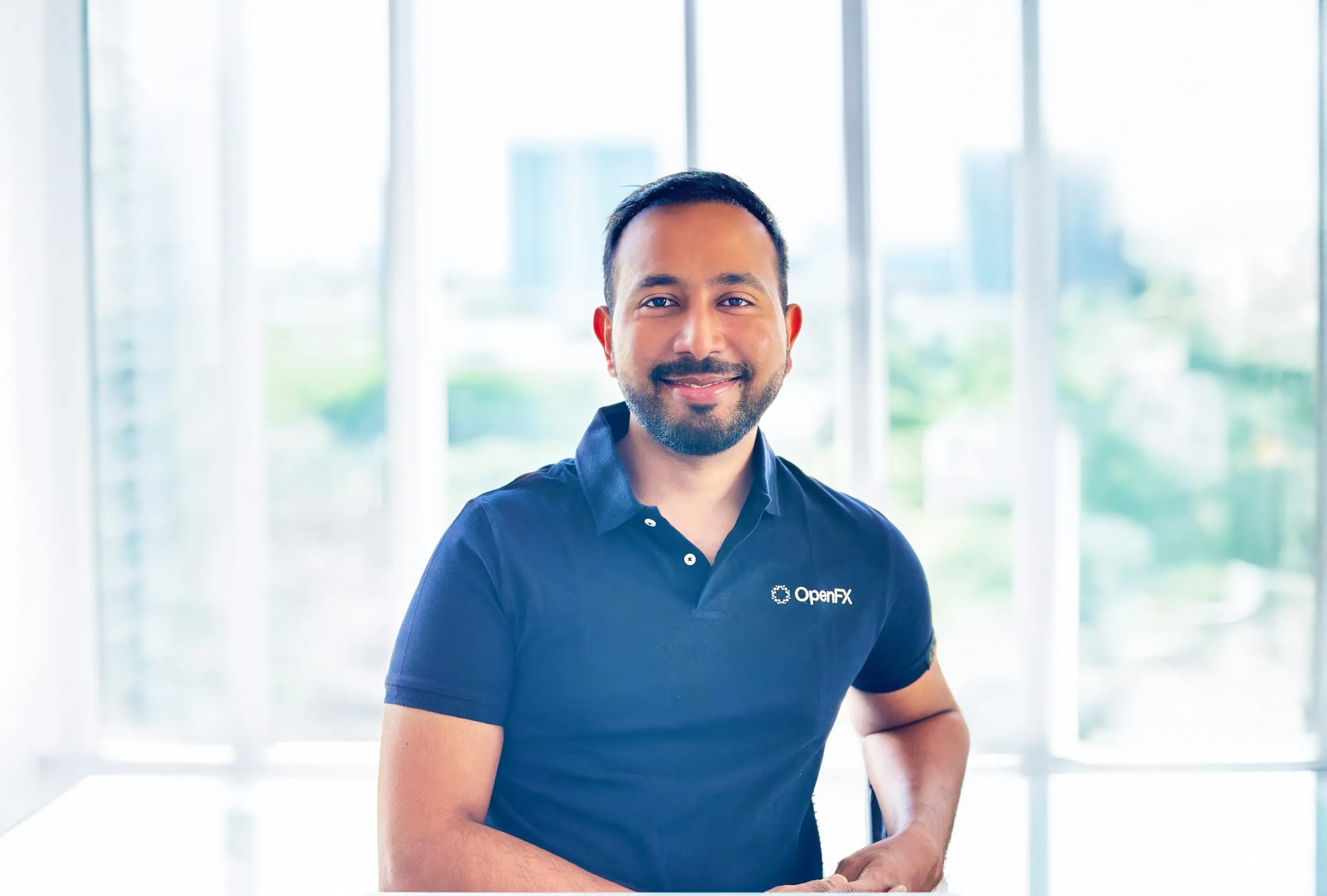
For Prabhakar Reddy, simplicity and complexity come hand in hand.
Periodically, he finds serenity in silent meditation retreats. A week or a fortnight spent in total silence, totally uncontactable, with nothing but his thoughts.
These give him the clarity for when he comes back to his role leading OpenFX, one of the fastest-growing cross border payments companies globally. Complexity is at its very core, as they work to modernize FX, moving money using stablecoins through the hardest corridors on the planet, each with their own unique local banking systems, compliance frameworks, and regulatory needs.
As founder, he must find the simplicity in these overlapping domains, all while keeping the company funded and hiring the best possible talent.
“It requires a bit of unhinged thinking,” Prabhakar laughs.
If the scale of the challenge is eye-watering, then so is the momentum that Prabhakar and OpenFX has achieved so far. Their cross-border payment technology is fundamentally rewiring our global money system, enabling transactions that used to take days, in a near-instant. In just two years, OpenFX’s annualized total payment volume (TPV) has hit $70BN. In the time it takes to finish this sentence, they will have moved half a million more.
So what kind of person does it demand to rewrite a $200TN market with a radical new technology?
An eye for opportunity
Prabhakar has led his companies to multiple exits and one unicorn valuation, not an outcome you would associate with someone who considers themself a “reluctant” founder. Yet he remembers sitting in a university class, listening to a famous entrepreneur, and thinking, “This couldn’t be further from me.”
But circumstances often throw up the most interesting lessons. During the 2008 global financial crisis, he saw his father get let go from a company he had worked at for 25 years. Prabhakar was working in a similar corporate job, with a similar two-decade career path mapped out ahead of him. He thought: “If this is where I’ll end up in 25 years time, I really don’t think it is a path I want to take.”
He tried his hands at all sorts of businesses. The first, a film and anime blog, started out as a bet and ended up profitable in a matter of months. Another, the streaming platform Dramatize, was acquired by Accel-backed BookMyShow, and provided him the opportunity to join Accel as an investor.
Joining the firm that has backed some of the biggest global technology successes has had a huge effect on Prabhakar as a founder, and the way he thinks about entrepreneurship. “I got to see what being a world class founder means,” he says, “How they hire, how they run their boards, how to make decisions at a multi-billion dollar scale.” Sitting on the other side of the table also gave him a strong perspective on how investors value their bets. “I understood that the companies they invest in have to be able to return billions of dollars.”
The impact was huge. His ambition stretched from niche challenges to global problems, ones with billion-dollar markets at stake. At the same time, a new multi-trillion dollar asset class was emerging: cryptocurrency.
An introduction to crypto
Crypto first piqued Prabhakar’s interest as a hobby. He spent his evenings researching new cryptocurrencies, reading about exciting investment opportunities, and more often than not, putting money where his mouth was. The hobby quickly paid off: Prabhakar was one of the top traders on the three biggest exchanges, and started building a complex trading platform effective enough to sell to hedge funds.
The bigger opportunity was not lost on him: “I was a VC trying to find other entrepreneurs who were doing something interesting in a very large sector, and here I was having built something that I would have invested in.” And so he did, he invested in himself, he left Accel, and FalconX was born. Founded in 2018, it became the largest crypto prime brokerage, reaching an $8BN valuation by 2022.
Another project that started as a hobby and turned into something colossal. The billion-dollar founders he was looking for at Accel? He had become one. But even more valuable was the insight it gave him: into how crypto worked, and what it enabled.
This was felt strongest in cross-border payments. He could send a billion dollars worth of Bitcoin from the US to Japan in 10 minutes; but if he tried to send $10 million in fiat, it would take five days.
“Crypto is 24/7/365. There is no Christmas, there's no New Year's, there’s no Thanksgiving.”
This insight felt like a far better encapsulation of our modern money system, and of the direction that technology is driving us in. And crucially, it wasn’t captured by the existing payment system that we currently relied on. Payments needed a complete rethink: and Prabhakar had the solution.
This idea of “always on” money felt like a far better framework for our modern financial system, he thought, and it was the direction the technology was driving us towards. Crucially, it was also an opportunity that wasn’t already captured by the existing payment systems that we rely on. Prabhakar decided that payments needed a rethink, and that he could provide the solution.
An FX problem, not a stablecoin problem
Prabhakar openly admits that he can’t take credit for bringing stablecoins to the cross-border payments space. Quite the opposite: he remembers reading a ton of articles describing stablecoins as this ‘silver bullet’ that could solve FX.
But what he saw was the disconnect. In Dubai, where Prabhakar had recently moved back to, low income workers were queuing up at the Western Union to send paychecks home, paying 7% in fees and sometimes waiting days for money to make it back to their families. “This was the case in the 80s, the 90s, the 2000s, and in 2022 it was still the same.” So when people were saying that the problem had been solved, he couldn’t quite understand. “Why are they not servicing the sector that actually has the highest need?”
The reality, he soon discovered, was that the majority of these companies were just building wrappers around traditional banking services. They were moving stablecoins from wallet to wallet, but not actually converting them into fiat. Until the day you can spend stablecoins at your local coffee shop, that last mile was more important than any mile that came before it.
The problem wasn’t stablecoins, it was FX, and the FX problem was extremely complex. No single company wanted to take on the whole thing, they just wanted to address a small niche they could control profitably. Meanwhile, traditional banks certainly weren’t going to solve it: “They’re in the business of holding money, not moving it,” Prabhakar says.
The system needed to be rethought from the ground-up, and it needed to be built by someone willing to embrace its complexity, who could take on the full breadth of the problem, and find the simplicity that would turn it into a product for the whole world. If no one else would take it on, then Prabhakar would.
Finding product-market fit & hitting lightspeed
Prabhakar distills OpenFX into a simple set of ideals. In a world where average settlement time takes five days, 98% of their transactions settle in under 60 minutes. Where the fee per transaction averages around 3%, they bring it down to fractions of a percent.
He tells an anecdote that crystallizes the impact they’re already having in a multi-trillion dollar market: shipping. Every time a ship comes into port, they pay fees to dock while they unload their containers, anywhere between $5000 and $25,000 per hour. Ships wait days for payments to clear, for money to travel across borders, currencies, and timezones.
With OpenFX, these payments can be cleared in less than an hour, often minutes. Ships move in, ships move out. The economy stops idling in port, and money is no longer left at the mercy of outdated FX systems. “That encapsulated product-market fit in my mind: seeing a ship move because a payment it relied on cleared in 60 minutes instead of five days,” Prabhakar recalls.
This is just a fraction of the impact they’ve seen so far, which has fueled their phenomenal growth. In their first year, they processed $1BN. By the 18 month mark, they were doing $1BN a month. Later this year, they’re on track to start doing $1BN a day. Just two years in, their total payment volume (TPV) is $70BN. By comparison, Wise, a public company started 15 years ago with over 6500 employees, is doing $250BN.
OpenFX currently has around 140 employees globally, and supports over 40 currencies. In the last few months, they’ve launched currencies from Argentina through to the Philippines.
Across a two-year rollercoaster, Prabhakar’s role as CEO has morphed from on-the-ground builder to orchestrator and overseer. His time is currently dedicated to three key responsibilities: “pointing the ship in the right direction”, “keeping the company sufficiently capitalized”, and “bringing in A++ talent”.
On fundraising, he’s had notable success, raising $117M across the last few years including a $94M Series A earlier this year which included investment from Northzone. "I've known Sanjot Malhi (who led Northzone's investment) for over a decade, so the trust was already there. He and his team brought a deep, distinctive and specific thesis on the future of cross-border payments, built over several years. The alignment in vision was there from the get-go and I knew this was exactly the kind of partnership we were looking for."
On the latter point, this is a skill he has sharpened since his earlier businesses. Culture, he believes, is something you have to be intentional about from day one (he created a culture document before the company even incorporated). He has also aimed high with hires, bringing in senior leadership experience early on rather than waiting for people to grow into senior roles.
“People who've seen scale can operate very differently than people who have not.”
While the company and the team has grown globally, Prabhakar’s approach remains very hands-on when it demands it. His mantra: “Be fully present in every interaction, because my attention is my currency.”
The future
OpenFX has no shortage of ambition. They’re targeting a $200TN market - the current annual volume of cross-border transactions, around double global GDP.
But for Prabhakar, even this doesn’t represent the ceiling of his ambition. He analogizes to the digital transformation of the postal system towards digital messaging. He sees it similarly to what happened when the postal system was replaced by digital messaging, “The change wasn’t 100,000 letters a day to 120,000 texts. It went from 100,000 letters to 300 billion messages a day”
OpenFX isn't just seizing a portion of the FX pie, they’re radically increasing the size of the pie, and building infrastructure for a world that wants to move money at the speed of data. The demand is only increasing, as he predicts AI agents will come to process the majority of payments over the next five years.
Stablecoins still have a number of hurdles to jump over. The first is regulation, which is still fragmented, and the second is consumer adoption of a brand new way of moving money. But for Prabhakar, stablecoins were never the point. The technology is only as important as what it enables the company to do: simplifying complexity. For this, and for every decision he makes as CEO, he comes back to the same notion: moving money as quickly and seamlessly as possible.
“We’re married to the problem, not to the solution.”