It all started with a 104-degree fever.
A young Steve Gutentag was rushed into the hospital, his temperature soaring beyond the point of concern. The urgency of the treatment he needed was obvious to his doctor parents, but its cause was less so. And so, they waited. And waited.
While his temperature settled back down, it took over a year of Steve attending appointments with the best specialists before he received the diagnosis that might explain his dangerously high temperature. He had Crohn’s Disease, a lifelong chronic condition.
Steve often reflects on this frightening episode. “What would have happened if I'd gotten that diagnosis and treatment a year earlier? Or on the flip side, what if I’d gotten it a year later, or not at all?”
Steve’s own experience offers a glimpse at an alarming truth about chronic health: over 75% of US adults have at least one chronic condition. Unless you have the same privilege or medical access that Steve had, you’re going to go through even longer struggles to receive diagnoses, access treatment, and obtain ongoing care. As the scale of these conditions increases, so do waiting times and the overall burden on a thinly-stretched health system.
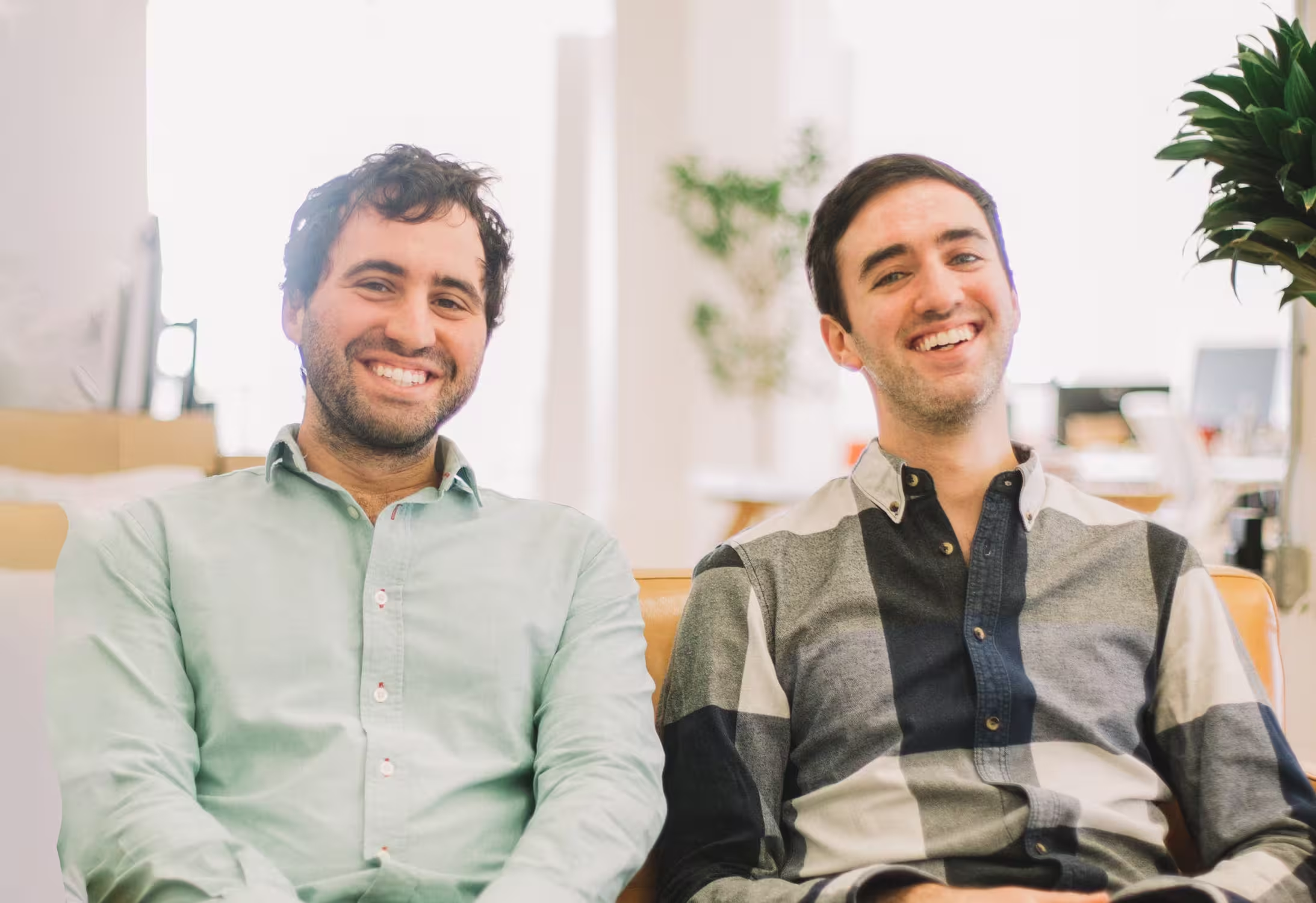
In building Thirty Madison, Steve and his co-founder Demetri Karagas have realized the problem isn’t simply a medical challenge. It’s more fundamental than that. It’s a case of customer experience, access, and fairness. From diagnosis through to outcome, they want patients with chronic conditions to experience the best possible process, regardless of where they’re from.
“Privilege shouldn't be the only thing that allows you to get access to great care.”
Outsiders coming into healthcare
Meeting in their first week at the finance-oriented NYU Stern, Steve and Demetri found themselves far more drawn to entrepreneurial problem-solving than the promise of a high-flying finance career. They’d built businesses before college, and always had their eyes on the next opportunity.
That’s what made them click, almost instantly. They built their first business—Sitesimon, a browser-based content recommendation engine—straight after graduating; their second business, on-demand cleaning platform Get Maid, was acquired by Homejoy.
The latter gave them their first real taste of startup success. But it also gave them a fascinating insight into an underlying principle that they could apply to their next venture.
“How do you create enjoyable online experiences that connect to the offline world?” Steve says.
This brought them back to the experience of patients with chronic conditions. Steve’s own experience with Crohn’s disease, a potentially life-threatening condition, and Demetri’s experience of hair loss, which impacts two in every five men. Two vastly different conditions, but facing surprisingly similar challenges around access to care and treatment.
One small issue stood in the way. Neither Steve nor Demetri had any experience in healthcare. So how do two outsiders transform a complex, highly regulated industry?
In many ways, they saw it, and still see it, as an advantage. They call it the ‘beginner's mindset’. “You don't know what you don't know, and you're not jaded by the challenges of an industry that is incredibly complex, slow-moving, and not super willing to change,” Demetri outlines.
And after all, the idea was a no-brainer. “We were simply making the experience better for the patient, so why wouldn’t this work?”
Changing the status quo, and people’s minds
The reality was quite different. Steve and Demetri realized from the outset that they would face resistance, complexity, and an immense learning curve.
They decided to start on the ‘lighter side’ of healthcare, with a more consumer-focused problem that wouldn’t even involve insurance yet. The prevalent condition of hair loss was the perfect place to start. Clinical protocols were much simpler, and it was easier to think through this user experience from a consumer lens. And after all, as men in their late twenties starting to experience hair loss, they were the target audience.
This all came down to testing a hypothesis. “We just said, if this works for hair loss, it will absolutely work for a lot of other stuff,” Steve says.
This mission—to create direct-to-consumer healthcare products and aftercare for specific, chronic conditions—feels obvious now. But when they launched Thirty Madison back in 2018, Steve and Demetri were coming against a considerably different healthcare landscape.
For one, D2C healthcare had become something of a taboo. “Direct to consumer had been tried a number of times, and every business had either died or pivoted to B2B,” Steve remembers.
In addition, asynchronous telemedicine was highly uncommon. It was mostly limited to video consultations for urgent triaging or diagnoses, not as part of ongoing care. “When we said we wanted to do both telemedicine and medication delivery all in one place, people said, ‘That's just not possible’.”
But their beliefs endured. The more they heard that it was impossible, the stronger their conviction grew. “We were so excited, we believed it had to exist, and it just wasn’t clear to everyone else,” Demetri says.
They didn’t take this belief for granted. Rather, they sat down and wrote out every single reason why it could fail. They needed to understand every possible factor and threat, and spend time figuring out what must be true to mitigate that.
And so the early days of the company were really focused on figuring out the equations that would prove crucial to the business’s success. They had to understand the clinical, regulatory, and patient sides. They had to get their heads around the pharmaceutical supply chain, from manufacturing through to provision. Throughout the process, across all of their conversations with experts, clinicians, and industry leaders, they had one core mission at the front of their minds.
“We had to ensure that what we were doing was the best thing, not just from a patient experience perspective but from a patient outcome perspective.”
Managing hypergrowth & maintaining quality
After months of discovery and fact-finding, in 2018 Steve and Demetri launched their first product, Keeps, a specialized, direct-to-consumer brand for men's hair loss offering FDA-approved, prescription treatments with reported 90% effectiveness in stopping hair loss.
But while D2C healthcare and telemedicine still felt like an outside bet when they launched, their odds flipped a few years later, across a matter of weeks. Just a few days after they closed their Series B, Steve and Demetri watched as the world started shifting into lockdown. The NBA started cancelling games, the President closed US airspace, and US markets dropped thousands of points. While other industries faced an existential crisis, COVID was a transformational turning point for what they were building.
Two key paradigms shifted overnight, both in terms of supply and demand. On the supply side, telemedicine became essential. “People who had been skeptical before were now able to try it, and realized the power of telemedicine at this time of crisis,” Steve says.
On the demand side, healthcare suddenly shot to the fore. “Unless you were a telemedicine company or a standing desk business, you stopped all marketing.” And so, in a matter of days, their cost of acquiring customers plummeted.
They still had questions to answer and problems to solve, but they realized, now more than ever, they needed to put their foot on the gas.
During COVID, Thirty Madison grew from 30 to 300 employees. They tripled their revenue and launched several new brands, including Cove (for migraines), Evens (for gastrointestinal issues), and Picnic (for allergies). In June 2021, they raised a $140M Series C, valuing the business at over $1 billion. Fueled by this expansion, they acquired Nurx (for women’s health) in early 2022.
But not everything panned out exactly as they’d imagined.
Culturally, the challenge of hyperscaling their team while transitioning to a remote working setup was incredibly difficult. The tightrope of balancing growth and quality was hard enough to tread, let alone ensuring the satisfaction and wellbeing of their employees.
COVID also threw up its own unique supply chain issues. Demetri remembers one particular scare, when stocks of minoxidil (one of their core products for Keeps) suddenly ran out, forcing them to make critical decisions about the quality and reliability of their suppliers. These moments are the test of any founder’s mettle, compelling you to learn, act, and mature at a vastly accelerated pace.
Demetri shudders at the memory of this incident, but is grateful for what it taught him. “You build up a bit of scar tissue; a tolerance to just say, ‘There’s only one thing you can do, and that’s to fix this and get to the other side. No one else is going to do that’.”
The challenges never disappear, he adds. “You get to that next phase, and you just realize you now have bigger problems to deal with.”
The consumerization of healthcare
With D2C and telemedicine light years ahead of where they started, Steve and Demetri reflect on the impact they’ve had on the industry. Steve nods at the “consumerization of healthcare” that they’ve been a major proponent of, with much more room for personalization when it comes to chronic conditions.
While Thirty Madison has covered several pertinent problems, from hair loss to migraines to women’s health, there is still a very long tail of conditions that need this same level of attention and transformation. “It’s a big space, with a lot of problems,” Steve acknowledges.
The booming industry of GLP-1s—the weight loss medications like Ozempic and Mounjaro that have transformed healthcare in recent years—is one space they’re turning their attention to. “It’s still far too difficult for many people to get access to the right treatment here,” Steve adds.
It was this market that started their conversations with Remedy Meds, the fast-rising D2C healthcare platform offering a comprehensive GLP-1 care program. In September 2025, Remedy Meds announced it was acquiring Thirty Madison. Together, they will be one of the largest D2C health platforms on the market, creating a powerful opportunity to scale their infrastructure for chronic healthcare.
While Remedy acquired Thirty Madison’s 500-person strong team, it was the end of the journey for Steve and Demetri. Both reflect on their most important learnings across the journey.
Firstly, stay focused and make tough decisions quickly. “It’s important to remember that, however excited you are about things, not everything works,” Demetri says. At some of their most critical junctures, whether that’s acquiring new companies or laying off members of staff, it’s been crucial to them to remain focused on the mission. “You have to be able to make those calls to say this isn’t working.”
Their second piece of advice—stay close to your customers. They’ve always had to ensure they deliver the best possible outcome. Technology is a critical resource for this, with AI enabling an entirely different paradigm of care, attention, and personalization. But no matter the scale, they’re never willing to compromise on quality, “whether that’s one customer or a million customers”.
Finally, and perhaps most pertinently, trust your gut. Founders navigate so much ambiguity over the course of scaling a business. This was especially true for Steve and Demetri, as outsiders in an industry with so much regulatory and infrastructural complexity. As much as you can educate yourself and listen to the experts, you sometimes just have to use intuition more than straight logic.
Steve explains: “There's always going to be certain instincts about what you're building that may not always seem obvious to everyone else. And I think more often than not, you can find really special opportunities and moments because of that.”