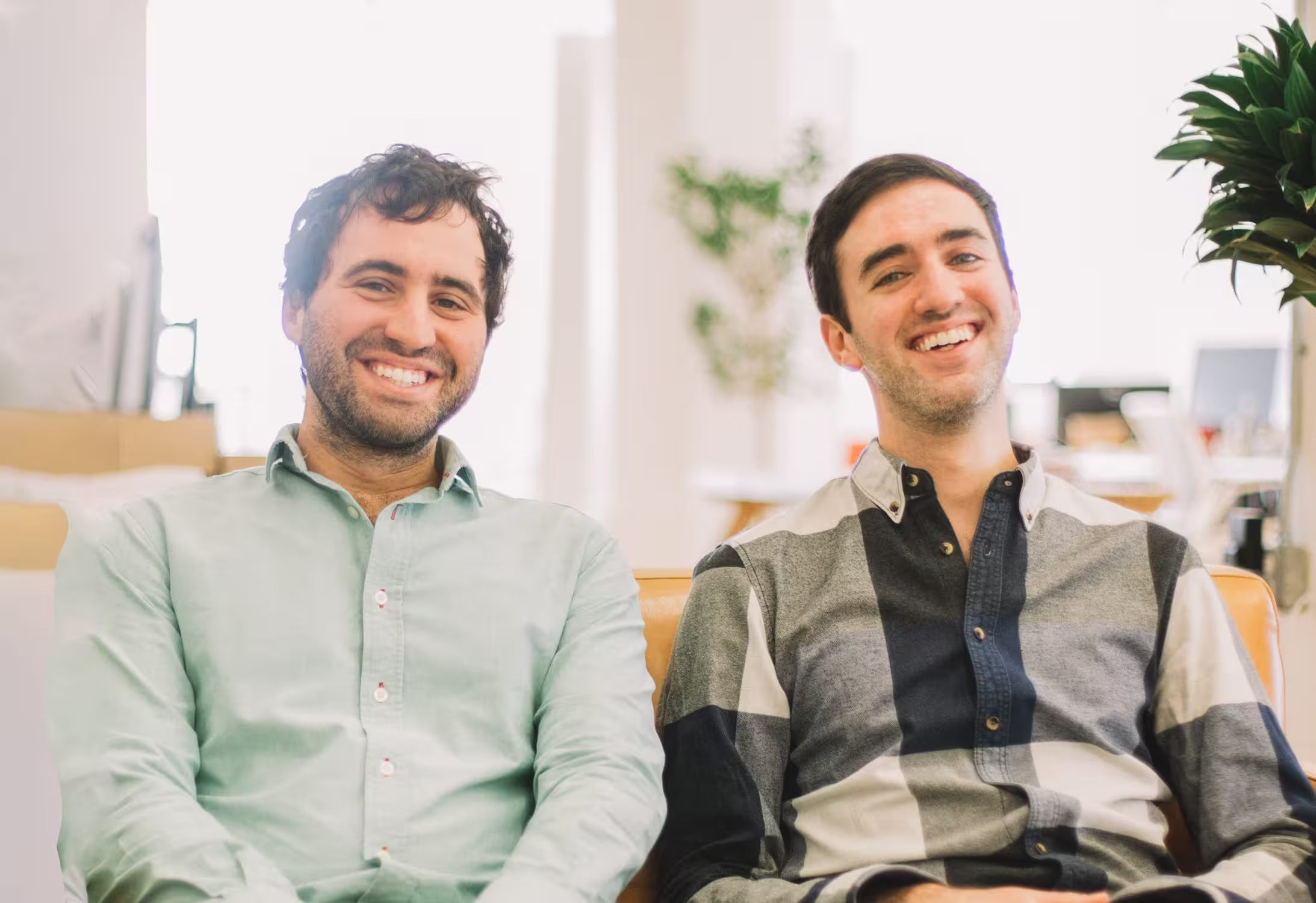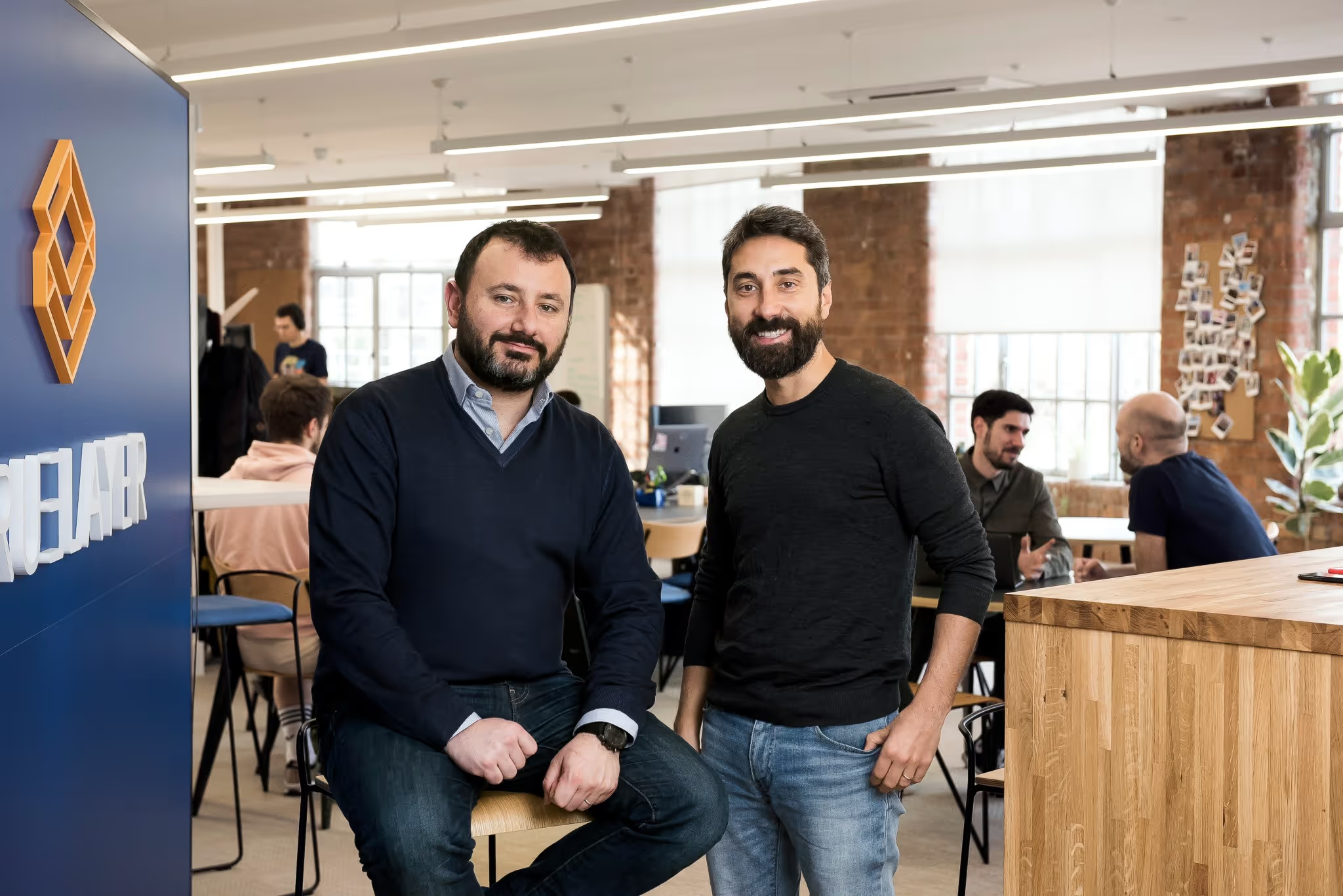
By their own accounts, Francesco Simoneschi and Luca Martinetti have always been outsiders.
Take their high school in Rome, when they first met. While their classmates threw themselves into more typical pursuits of young teenagers, these two fourteen-year-old boys lived in a world of programming and computing.
Their interests were “atypical”, Francesco says. In the late 90s, the internet wave had hardly touched Italy’s shores (just 1.5% of the population had internet access at that point). ‘Startup’ had barely been coined at this point; entrepreneurship meant running the family business. But being unconventional, and the only kids in their year who knew their way around a computer, Francesco and Luca clicked instantly.
Their misfit status continued after leaving school. “I’m not employable by any standard,” Luca admits. It’s fortunate, then, that this computer obsession, which once marked them as outsiders, was quickly becoming the catalyst for a new digital industrial revolution.
And so their hobbies turned into unconventional career paths. Wherever they went, from Rome to San Francisco to London, they found problems to solve and technology with which to solve them. Their lack of conventionality became an advantage. “Starting a business is the ultimate stand against the rest of the world,” Luca says.
This mentality has led them to their current venture, where they’re dismantling a decades-old status quo. TrueLayer is rebuilding payment infrastructure through ‘Pay by Bank’: an open banking payment method that enables instant, secure payments via direct bank connectivity. Never short of ambition, their pitch since day one has been to break up the Visa and Mastercard duopoly that accounts for 90% of all transactions.
The story of the company is one of upheaving an industry, of dizzying highs and intense lows. But more importantly, it’s a tale of friendship and enduring belief. “The story of TrueLayer is the story of Luca and me,” Francesco says.
Unmatched ambition, utter conviction
The entrepreneurial bug took hold of Francesco and Luca straight out of high school. That sense of infinite possibility enchanted them; that technology could just create something out of nothing.
But comparing the resources they have at their fingertips now to what they were dealing with back in the early 2000s, it’s astonishing that they got as far as they did.
Globally, startup culture was in its infancy. In Italy, it was practically non-existent. Startup communities, resources, shared learnings, and playbooks were scarce. “The closest thing we had to a business advisor was our accountant,” Francesco remembers.
Despite this, they successfully scaled and exited the business they built straight out of university. But Francesco and Luca realized they would need to look further afield to achieve the level of ambition they aspired towards. Silicon Valley came calling.
Here, they sat shoulder to shoulder with the category leaders of the future. They shared desks in co-working spaces with early incarnations of Uber and Instagram. “We went from zero role models, zero examples, zero expectations, into the premier league of startups. We learned so much every day just by osmosis,” Francesco says.
Through the company they kept and the people they met, Silicon Valley taught them volumes about belief, unmatched ambition, and utter conviction in your business. “You can be so unapologetic about building your own thing.”
The power of APIs
With another successful exit under their belts—Staq, an analytics platform for game developers to help retain and monetize players—Francesco and Luca felt the pull back to Europe. Compared with Silicon Valley’s ambitious hype machine, Europe had a balance of realism and pragmatism. It was a refreshing change.
For their next venture, they looked to Luca’s experience of building with APIs. This technology, which had been conceived of as early as the 1970s, became pivotal in enabling the new boom of applications to interact and interoperate with one another. They’d seen phenomenally successful businesses like Twilio, Stripe, and Plaid (where Luca had worked for just over a year) using APIs to transform industries through direct integration and data sharing. “We were looking for that next old school industry that could have an API moment,” Luca says.
At the same time, the financial industry was witnessing an emergence of open banking technology and legislation. Europe’s PSD2 law mandated that banks securely share customer financial data with authorized third-party providers, laying new financial foundations that would no longer be dominated by legacy players.
Francesco and Luca identified an opportunity for something groundbreaking: a new infrastructure that uses APIs to leverage access to banking data, delivering on the vision of a truly open banking system.
And like that, TrueLayer was born.
TrueLayer: A snapshot
Year founded: 2016
Number of employees: ~250
Amount raised: $321M
Total customers globally: 20 million
Annualised TPV: >$100BN
The knife-edge decision
Francesco and Luca started, as they’d always done, by solving a specific problem. Their early focus was on developers, building a simplified, unified aggregation service that would help fintechs integrate with banks.
While some companies wait years to find product-market fit, TrueLayer started seeing interest and traction almost instantly. “In some senses, we were in the right place at the right time. Everybody was discussing what might be possible, but we were actually doing something,” Francesco says.
The one hitch: their product was practically non-existent. APIs themselves were still in their early stages, so they had to simulate their product by screen scraping directly from banks’ websites. What they really needed to do was prove they understood the problem and had a solution ready to go. “We were selling a car based on its engine, meanwhile we’re pedalling away underneath.”
No startup journey is a straight line. While the API integration problem showed promise and demand, Francesco and Luca realized there was a much greater problem to solve around payments. Visa and Mastercard process billions of dollars in payments every day, so if they could cut out intermediaries and facilitate payments directly, there was a powerful opportunity to seize.
At a company offsite in a remote airport hotel, the decision was set in stone. Payments over data. Their whole company reoriented towards payment method development, with data as an enabling tool rather than the primary product.
It’s those knife-edge decisions that can make or break you as a business. Ignoring or avoiding these decisions can see you fade into mediocrity. Building infrastructure requires a “winner takes all” mindset, and there was no room for mediocrity.
The results speak for themselves. Scaling ‘Pay by Bank’ technology proved to be transformational for TrueLayer. In just a few months, they started processing billions in transaction volume and have now brought in clients across financial services (Revolut was an early customer), e-commerce, sports and gaming, and crypto. With every new client, the same principles apply: remove the frictions that have kept payments in a stranglehold.
“With infrastructure, the best user experience wins. So when you have something simple, quick, easy to understand, and secure, then every other payment technology becomes obsolete,” Luca says.
“What doesn’t kill you makes you stronger.”
As TrueLayer has scaled and matured, so have expectations on its founders. Francesco and Luca, who by their own admission are ‘unemployable’, are now responsible for leading and motivating their 250+ employees.
For them, leadership isn’t about hierarchy and dominance. It’s about accessibility, honesty, and vulnerability. This approach has proved invaluable at some of the company’s most challenging moments.
Take ‘Incident 37’ in 2018, a notorious moment in TrueLayer history that has reached near-mythical status. Both Francesco and Luca smile and grimace at its mention simultaneously. ‘Incident 37’ occurred early in their journey, when a data leak allowed customers to view other customers’ banking data. “I was convinced that was the day the company was folding,” Francesco admits.
Gut instinct might tell you to keep such a severe problem a secret. Instead, they owned the mistake, shared the problem with the whole company, and told them how they would work through it. It was a valuable learning experience for them and also a pivotal moment for the company to remember: “What doesn’t kill you makes you stronger.”
Whether working through those difficult moments or celebrating their many monumental successes, Francesco and Luca agree that it would be impossible to do this without each other. It’s not just that they have different skill sets and personalities: knowing each other as well as they do means they can have candid arguments and disagreements and still emerge stronger. And when things do get hard, they know how to rely on each other for support and guidance.
“You share the pain,” Luca says.
No time to pause
In late November, Francesco and Luca were up to their necks in the Black Friday sales. And not for some last-minute Christmas shopping: over the course of the weekend, TrueLayer processed more than $1 billion in payments, their first-ever billion-dollar Black Friday weekend.
It was a huge milestone, and yet another emphatic reminder of the demand for what they’re building. Over the next decade, it’s easy to imagine that these billion-dollar weekends will become increasingly normal. In that time, Luca expects that advancements in open banking and real-time payments will mean we’ll see a total convergence of online and offline payment experiences, with TrueLayer at the center.
In 2026, TrueLayer celebrates its tenth birthday. For Francesco and Luca, nearly thirty years of friendship. So what have they learned? Thinking back to his younger self, Francesco would tell himself to trust his intuition over conventional playbooks. “When you’re starting out, you should embrace naivety. It’s okay to say, “We have an intuition, and we’re going to tell the banking world how things are done.” For Luca: “Prepare for the marathon. There’s no such thing as overnight success.”
But birthdays and anniversaries aside, there’s not a day to waste resting on their laurels. “We’re almost ten years old, and every day I feel that I could do this ten times again, because there’s so much more to do,” Luca says.