
TLDR: Engineering is experiencing a fundamental shift. The boom of ‘AI engineers’ is more than just a hiring wave; it’s the result of AI becoming increasingly central to product development. AI is no longer a ‘specialism’, it’s an essential skill, and today’s engineers must fuse generalist software engineering with proficiency in deploying and evaluating AI systems.
The AI landscape has entered a new phase—transforming not just what we’re building, but who we’re hiring.
In 2025, experience and execution are critical to standing out. Companies are no longer looking for engineers with a passing familiarity with machine learning; they are prioritizing hires who can operationalize large-scale models, integrate AI systems into production environments, and build the infrastructure to support them.
Experience in deploying and maintaining AI systems and applications is growing. So what really matters when you’re hiring AI engineers? And where should you be focusing your efforts?
In our first ‘On The Pulse’ survey, we polled our global portfolio to learn more about their hiring strategy for AI engineers. Companies ranging from early seed stage prospects to global unicorns shared insights into:
- Current team makeup vs hiring intentions
- Background
- Key responsibilities
- Tech stacks
- Compensation
1. AI engineer hiring is ramping up at all stages
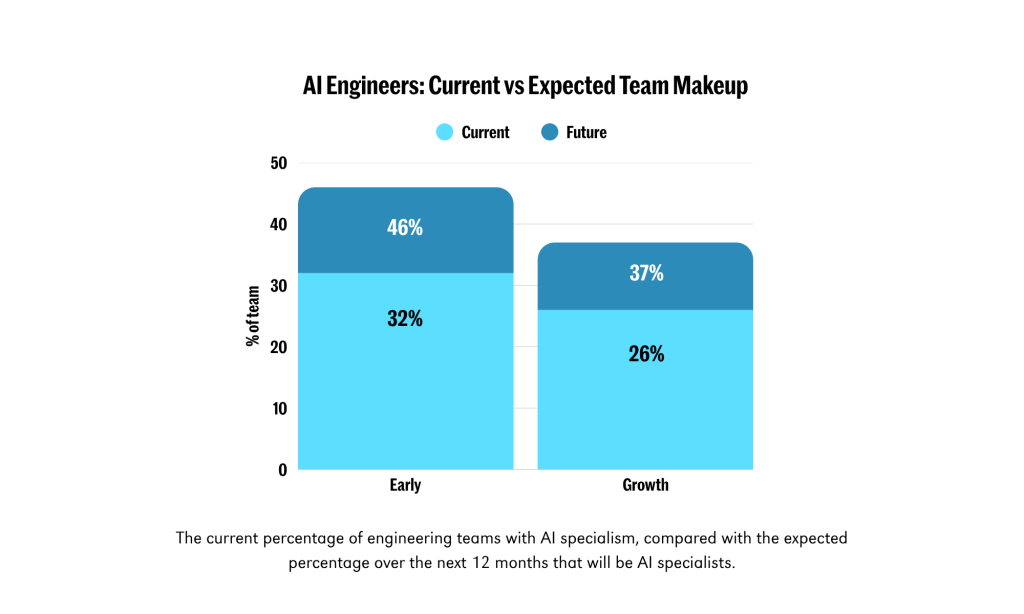
Our poll confirmed what we’ve been hearing anecdotally: that leading companies at all stages are cranking up their search for AI engineers. While AI engineers currently make up between a quarter and a third of engineering teams, hiring intentions suggest these numbers will increase significantly over the next 12 months.
For early-stage companies, AI engineers will soon represent nearly half of their engineering team. For certain respondents, this expected figure is as high as 70-to-75% of their engineering function.
One respondent highlighted their outlook: “Overall, all engineers at our company are supposed to be able to both build using LLMs and to build LLM features. Any AI Engineer also needs to be a good SWE to get things into production.”
We’re seeing a convergence of roles emerging across the industry. The best AI engineers are not just model-tuners or prompt specialists: they’re full-stack software engineers who can translate AI capability into the finished product.
2. Generalist SWEs are in high demand
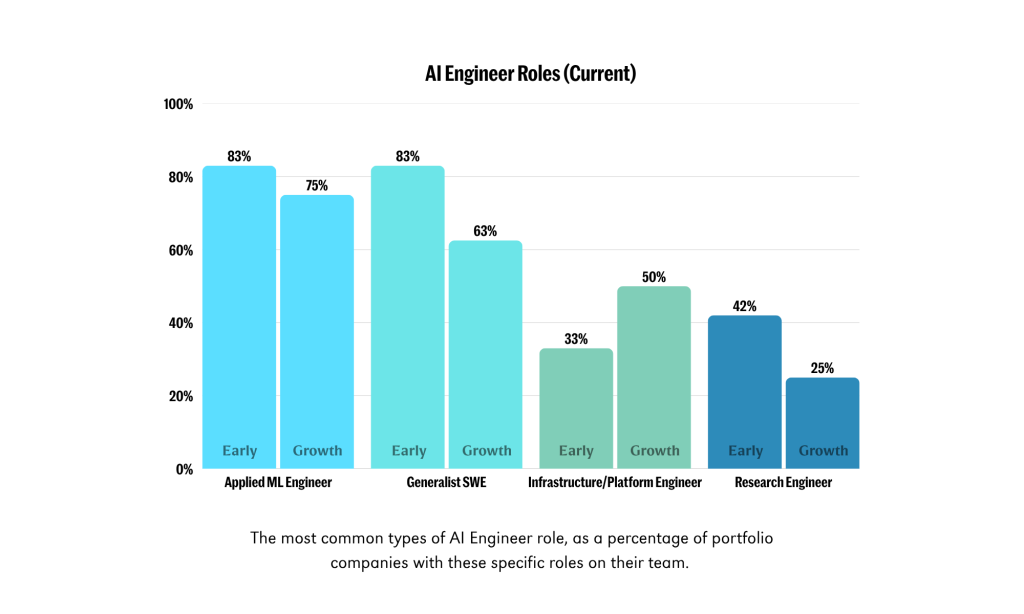
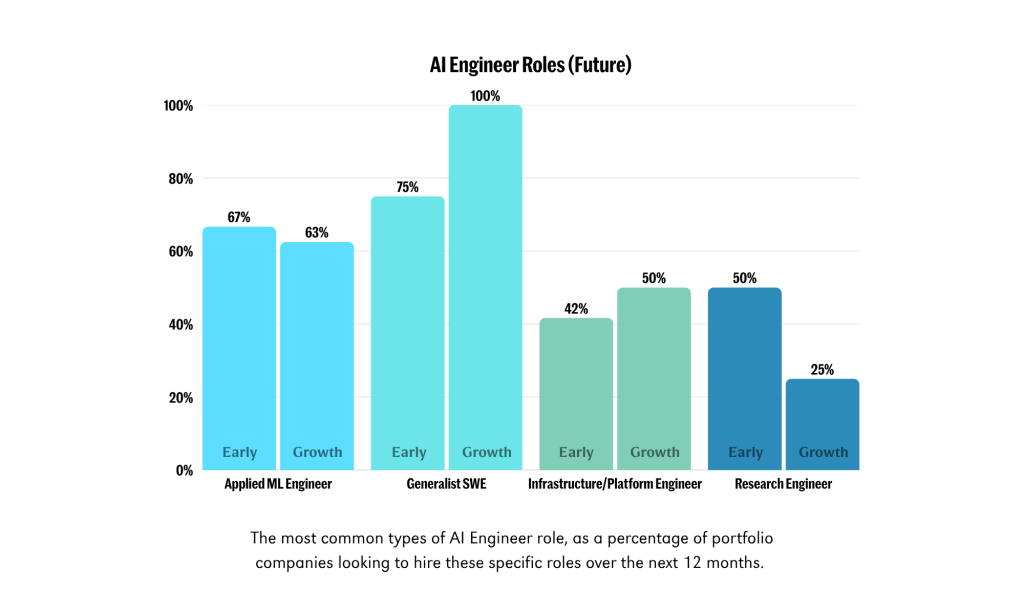
We asked survey respondents to identify which specific types of AI engineers they already had on their team, and who they are looking to hire more of over the next 12 months.
The Generalist Software Engineer stood out in both early-stage and growth-stage companies. Early-stage startups clearly depend on generalists to prototype and ship AI features rapidly, while later-stage teams increasingly value engineers who can integrate AI systems into existing architectures without relying entirely on ML specialists.
The Applied ML Engineer role followed closely. Hiring seems to remain consistent, suggesting satisfaction with this deeper specialization as a team asset. This parity suggests companies are largely satisfied with their applied ML capacity, while the next frontier of hiring is about bridging the gap between application logic and AI infrastructure.
What’s clear is that both these roles remain a priority. Generalists, to act as the connective tissue between AI capabilities and the product experience; and ML specialists, as the foundation for fine-tuning and experimentation, but best paired with generalists who can help operationalize their work.
3. AI is increasingly a function of product
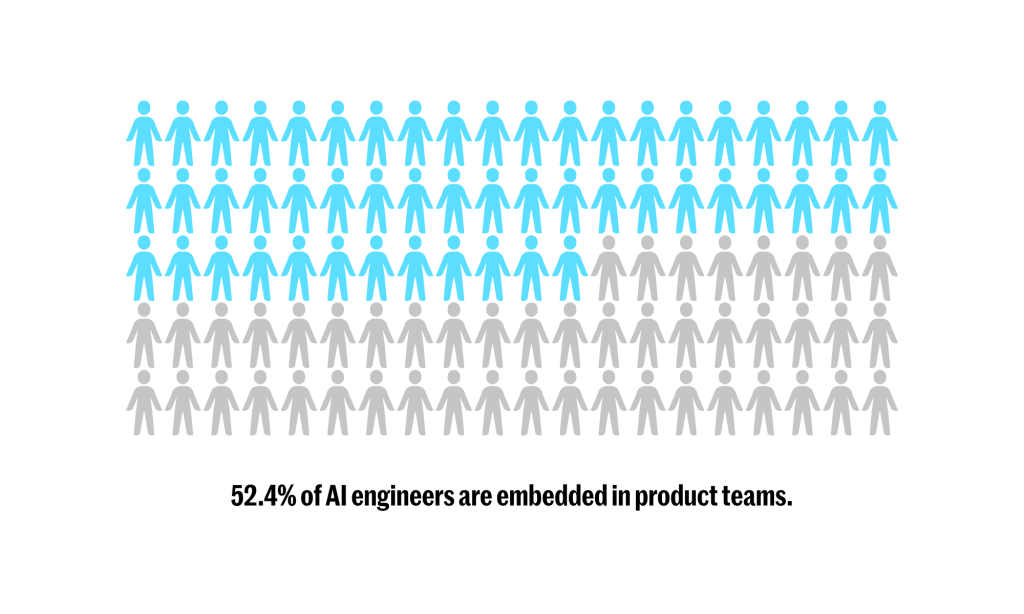
Our findings show a clear reorganization is underway in the world’s leading companies. AI is moving out of technical silos and into the product core, with over half of AI engineers found embedded in or near product teams.
In the past, AI teams were often treated as internal service providers, building models that others consumed; now, they’re co-owners of product direction. As AI shifts from a supporting feature to a core element of the value proposition, it demands tighter integration with product development. Performance is critical to the user experience, shaping user interactions, engagement, and retention.
You can see the full breakdown below. It’s noteworthy to see that 14% of AI engineers sit on the founding or leadership team of a business. While perhaps unsurprising for AI-native startups, this shift shows that AI strategy has firmly taken center stage.
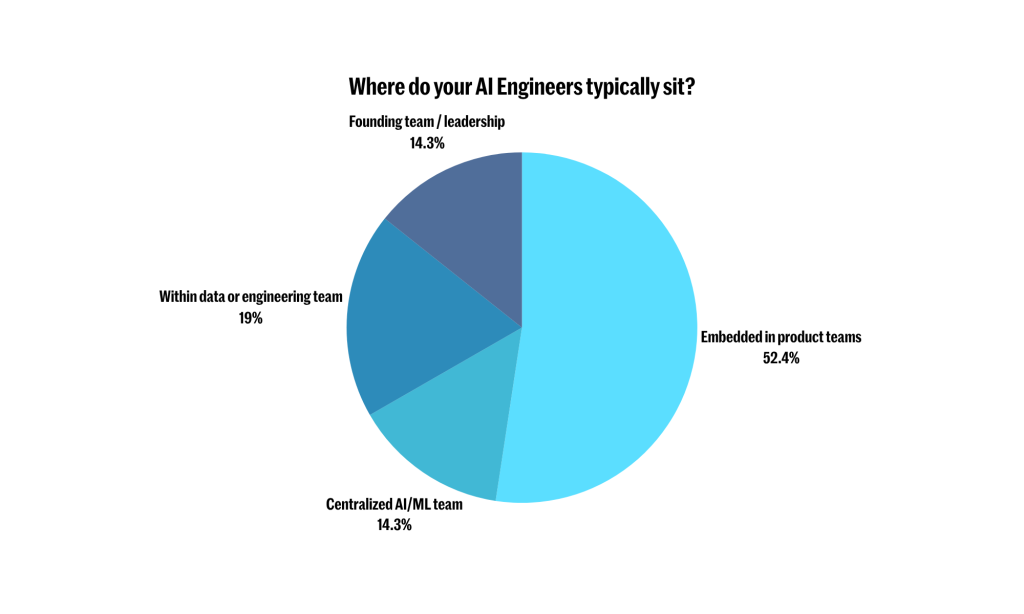
4. Responsibilities are shifting from model-building to model orchestration
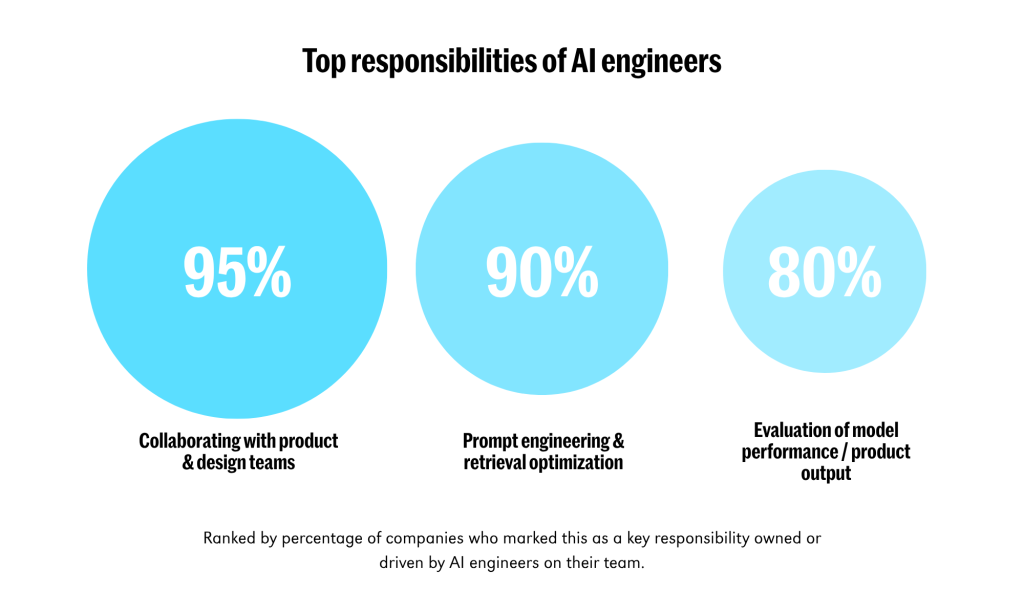
From our survey, there were three standout responsibilities where companies saw AI engineers focusing their efforts. Nearly all respondents cited ‘collaborating with product & design teams’ as a key responsibility, reinforcing the trend that AI engineers are now embedded within product teams rather than working in isolation. It also demonstrates how model performance and UX are now inextricably linked.
Here’s a breakdown of the other responsibilities listed:
- Prompt engineering & retrieval optimization – 90%
- Evaluation of model performance/product output – 80%
- LLM stack building (RAG, chaining, agent workflows) – 70%
- Fine-tuning or customizing LLMs – 50%
- Infrastructure (inference, GPUs, serving at scale) – 35%
- Building and deploying machine learning models – 5%
This last point is striking. Just a few years ago, AI engineering was synonymous with training and deploying custom models. This responsibility, however, is now much less common. Models are increasingly accessible, and instead, AI engineers are moving to the center of product development, building systems and products on top of these models, and occupying a crucial function in startup teams.
5. Generalists are switching into AI proficiency
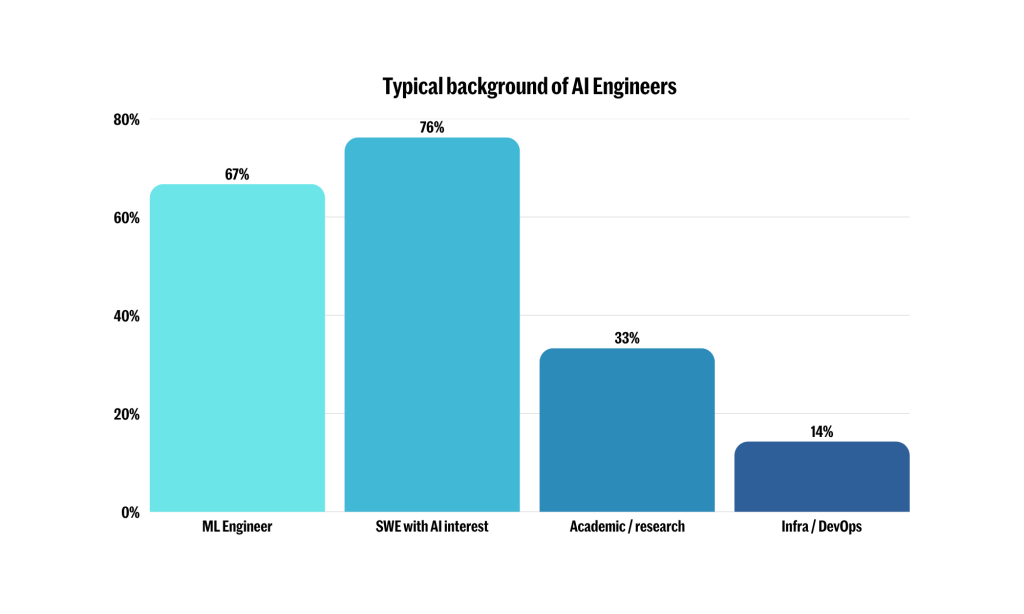
So, where are best-in-class companies finding their AI engineering talent? The largest group in the talent pool consists of generalist software engineers who have upskilled in AI, closely followed by more specialized machine learning engineers.
Far less common are those from academic or research-based backgrounds, or those with infrastructure or DevOps experience.
One respondent summarized this perfectly: “We believe that developing and deploying AI agents into the real world goes beyond hiring highly specialized AI engineers and should be, in a nutshell, organic to the Product and Tech teams.”
This confirms previous findings that AI proficiency is becoming an expected layer of technical literacy, not a separate discipline, and the best teams are empowering existing engineers to become fluent in AI workflows. With foundational models becoming more easily accessible, demand has shifted from those who can build models to those who can execute on top of existing foundations.
6. AI salaries haven’t spiked—yet
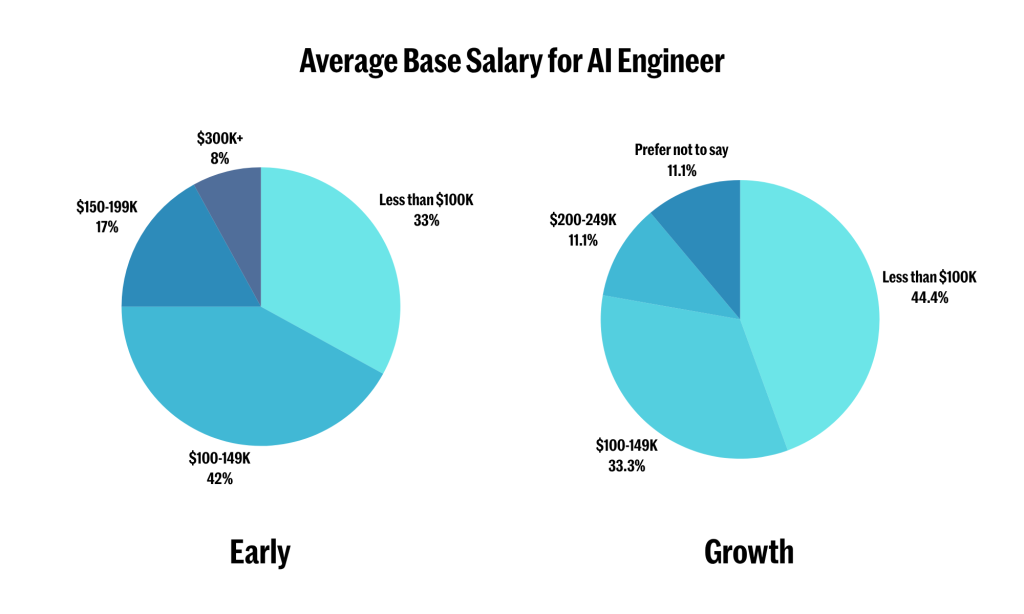
When it comes to compensation, our survey revealed a surprising degree of consistency across company stages. Around three-quarters of AI engineers earn $150,000 or less in base salary, whether they work at early or growth-stage companies.
This suggests that, for now, the AI hiring market hasn’t reached the hyperinflation seen in other technical roles. Supply is still emerging, as we’ve seen that many AI engineers are generalists upskilling into AI, so their compensation is likely to mirror that of traditional software engineers.
There are signs, however, that this equilibrium won’t last. Almost every respondent stated that they would pay AI engineers either the same or more than other engineering hires. One respondent noted that they are struggling to attract AI engineers within current salary bands, hinting that compensation will likely rise as demand continues to outpace supply.
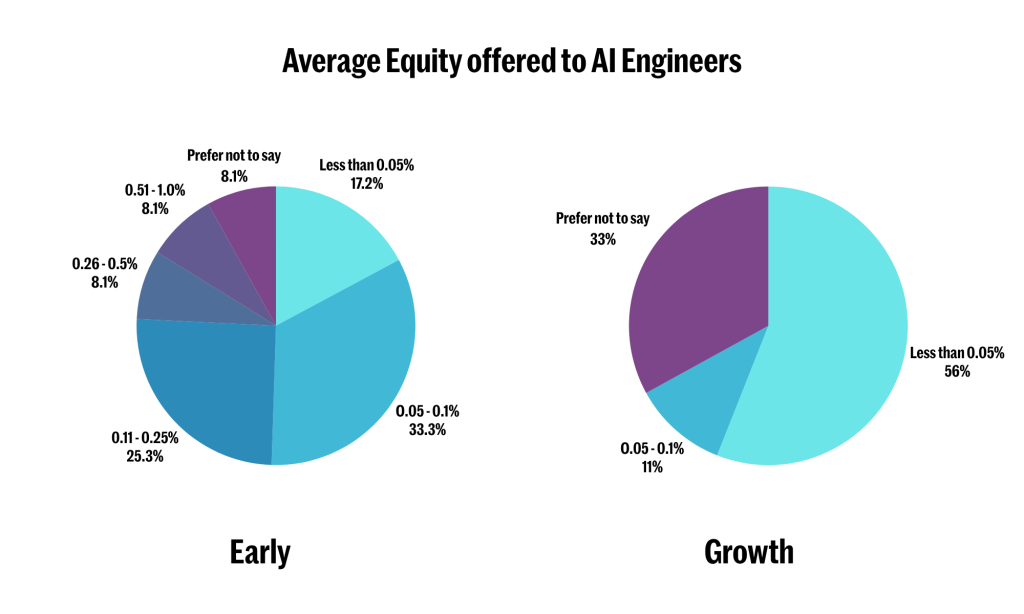
Equity demonstrated more variation between stages. Higher equity, as might be expected, is offered to those at earlier-stage startups as a way of attracting people to higher-risk opportunities.
Our Takeaway: the ‘AI Engineer’ marks a fundamental shift
Our findings have strongly supported our hypothesis that AI engineers are in high demand.
But what’s increasingly clear is that we’re witnessing more than just a hiring boom. We’re seeing a shifting definition of what an engineer is. Just as ‘web engineers’ became ‘software engineers’ in the 2010s, we expect to see ‘AI engineer’ become synonymous with ‘engineer’ in the next 12 months.
Fundamentally, AI is no longer a specialist skill set—it’s a literacy that will be table stakes for most software roles. Top hires will be expected to combine traditional SWE rigor with modern AI workflows. Moreover, companies no longer need to depend on hard-to-find machine learning PhDs or research scientists; instead, they can invest in upskilling versatile engineers who already understand the product, codebase, and infrastructure.
All this reflects fundamental changes in how companies work with AI. High-quality foundational models are increasingly accessible off the shelf, meaning most companies are no longer training models from scratch. The real engineering challenge moves up the stack towards orchestration, reliability, and differentiation.
The best person for the job? The generalist, it would seem.