
Why Now: Our Perspective on Legal AI
The past 18 months have seen an explosion of interest, headlines, and capital in Legal AI. Law firms are trialling various solutions or building in-house. Investors are placing bets. Products are racing from prototype to production. Lawyers are figuring out how to incorporate these tools into their daily work.
And yet, we haven’t placed a bet.
Not because we weren’t interested, but because the space was (and in many ways still is) noisy, fragmented, and hard to parse. From our earliest calls with law firms to hours spent unpacking what real usage looks like inside teams, we’ve tried to cut through the hype and focus on signal.
We’ve now spoken to 20+ companies, from rule-based incumbents to GenAI-native upstarts. We’ve interviewed over a dozen law firms across Europe and the US – from global giants to innovation-forward boutiques. We’ve tested products, compared user workflows, and pressure-tested with legal buyers, CTOs, and heads of AI. Some of the most revealing conversations came not from innovation leads, but from the associates using these tools day to day.
That’s why we’re publishing this now. Our belief is simple: Legal AI is inevitable, but how it gets adopted is still up for grabs.
The surface is crowded, the workflows are sticky, the needs are fragmented. But we’ve formed our view on what matters, where the value will accrue, and what kind of company we want to back. This space is moving at a breathtaking pace, and so our thesis is not final, but constantly evolving – we’re opinionated but not rigid.
It’s an invitation to discuss, challenge, and build. It’s us saying we believe in this next frontier – and as an investor with a 30-year history of backing the builders who changed the narrative, we’re stepping in – not just observing.
So if you’re a founder building in this space, we’d love to meet you – hear your story and learn how your view matches ours… or doesn’t!
Why Legal AI Is Inevitable
Legal AI is no longer a fringe thesis. It is becoming a strategic imperative.
What changed?
First, law firms are under increasing pressure – from clients, competitors, and their own partners – to show AI capability. What started as experimentation is now a signal of sophistication. In RFPs, in client pitches, in partner boardrooms, firms are expected to have an AI answer.
Second, the budget is shifting. LegalTech, for decades, operated under a ceiling – tools were funded from innovation or IT budgets, rarely touching actual legal services spend. That’s flipping. Legal AI tools are now being seen not just as operational software, but as a margin lever: improving efficiency, reducing junior workloads, and delivering better client service. AI allows vendors to tap into legal budgets, not just LegalTech budgets!
Lastly, the tech has matured. Foundation models can now handle a wide range of legal tasks at a passable quality. Privacy and deployment options are catching up. This opens the door for AI to augment, not just automate, real legal work.
So yes, Legal AI is inevitable. But inevitability doesn’t mean clarity. Adoption is still patchy. Procurement is slow. Many firms are layering AI tools onto old workflows.
And that’s where opportunity lies – not in proving this market will exist, but in building what it actually needs.
The Legal AI Timeline: From Tools to Workflows
The last two years have felt like multiple generations in one. Here’s how we’ve seen it unfold:
PHASE 1: THE POINT TOOL ERA
Before GenAI, LegalTech was defined by narrow, rules-based tools: Litera for drafting, Kira for contract review, iManage for document management. Useful, yes, but rarely transformative. Adoption was high, satisfaction was low. These were tools lawyers used because they had to, not always because they wanted to.
PHASE 2: THE GENAI SPARK
The launch of GPT-3.5 and GPT-4 sparked a wave of new entrants: legal copilots, AI associates, drafting tools. Most early players started broad – summarise, redline, draft – offering general-purpose capabilities that felt powerful in demos. But they struggled to embed into lawyers’ day-to-day workflows across the law firm.
PHASE 3: THE VERTICAL RECALIBRATION
By mid-2023, a shift began. Companies like DraftWise and Spellbook leaned into more verticalised use cases. Instead of selling to every lawyer, they focused on transactional law, contract lifecycle, or in-house legal teams. Meanwhile, horizontal players like Harvey and Legora raced to build feature depth and workflow integrations to maintain their breadth.
PHASE 4: TRIAL, FRAGMENTATION, AND EMERGING CHAMPIONS
Today, most major firms are running multiple live trials, often not just one, but two to five tools at once. Many are still deciding whether to build, buy, or blend both. We’ve heard of firms piloting Harvey and Legora in parallel, while using DraftWise for contract intelligence and internal tools for precedent retrieval.
Within firms, champions are emerging. Power users are building prompt libraries, training colleagues, and driving adoption from the ground up. It’s messy, but it’s real adoption, and it’s a sign that this market is entering its second act.
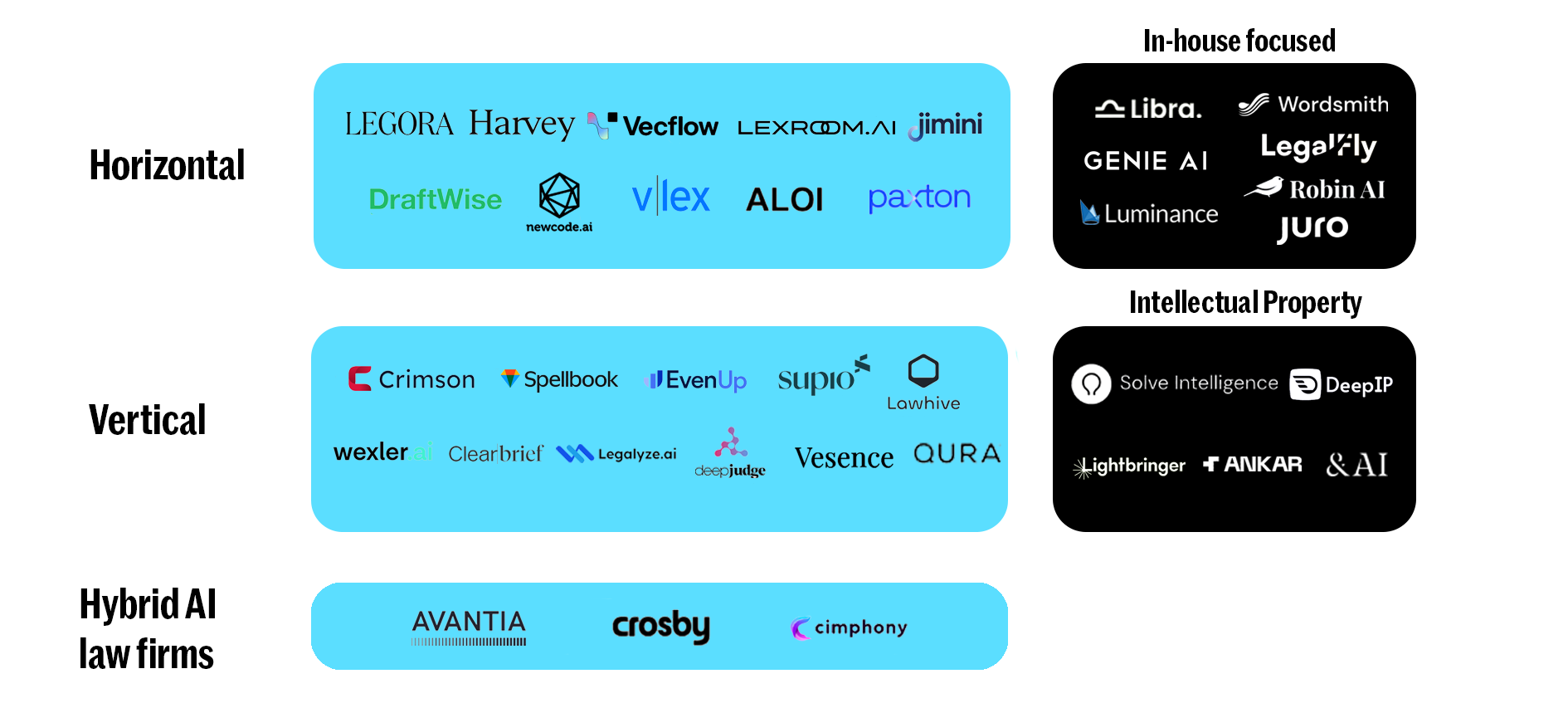
We’re mapping the space – from horizontal platforms to point tools to vertical specialists. One emerging trend: hybrid law firms like Crosby and Cimphony, which embed AI at the core of their value proposition. We’ll include our own market map here – but it’s fluid, and that there are many that we have missed. If you’re a founder we’ve missed, or disagree with our placing, please get in touch.
The core message remains: no one has won. Many players are evolving. It’s still early days, and we’re only beginning to grasp how much legal work will change.
And that’s what makes this one of the most exciting open spaces in AI.
Inside the Market: What Firms and Founders Taught Us
We’ve spoken with over a dozen law firms across Europe and the US, and 20+ startups. our takeaways are clear. The market is real, but messy. Adoption is happening, but uneven. We narrowed it down to six key insights we keep coming back to:
1. CAPTURE USERS IN THEIR NATIVE ENVIRONMENT
Lawyers live in Microsoft Word and Outlook. Any tool that forces them to switch context, browser tabs, logins, or clunky web UIs face resistance.
The best adoption stories we’ve heard come from firms using tools with native Word integrations. The reason is simple: it works where they work.
This isn’t just about UI. It’s about trust. Lawyers are more likely to try, use, and stick with tools that feel embedded into their daily flow. Workflow ownership starts with interface relevance.
That is not to say this is the long-term future. But pulling lawyers out of their native environment today is a real hurdle.
2. ADOPTION IS UNEVEN, POWER USERS MATTER
AI tool use inside firms is highly asymmetric. Junior lawyers – especially in transactional teams – tend to be early adopters. Partners often lag behind.
A “champion model” is emerging. A small number of power users drive experimentation, build internal playbooks, and nudge others into usage. At firms seeing traction, this motion is starting to formalize.
It’s not just the product, it’s the people inside the firm who advocate for it..
3. ROI IS REAL, BUT HARD TO PROVE
Unlike task-specific vertical AI, like Tandem in healthcare or Cursor for devs, legal copilots are used across highly variable tasks,making attribution fuzzy.
Every firm agrees there’s deep value, but quantifying it is tricky. A document review that takes five minutes instead of 30 is meaningful, but hard to track. Tools are often used ad hoc, making standardized reporting difficult.
That means selling into law firms requires more than just ROI numbers. You need clear use cases, specific team value, trust, and testimonials that carry weight.
4. NO ONE OWNS THE WORKFLOW YET
Most tools today act at the task level – redline this clause, summarize that contract. But legal work doesn’t operate in isolation.
In an M&A process, diligence review informs drafting, which links to negotiation, which feeds into closings. Litigation workflows are even more complex. Capturing these end-to-end chains is the next frontier.
Right now, no player truly owns an end-to-end workflow yet. That’s the next big opportunity. We’re watching players like Legora’s Workflows, Spellbook Associate, Harvey’s Workflows, and DraftWise’s AI Associate closely – just to mention a few.
5. CHATGPT IS THE QUIET COMPETITOR
Lawyers across firms admit they use ChatGPT for first drafts, summaries, and brainstorming – often quietly.
It’s fast, high quality, and increasingly reliable. But lacks what law firms care about most: privacy, security, deep domain integration, and workflow context. Real value can most often only be achieved when uploading sensitive documents.
ChatGPT will improve on all of those fronts. But the opportunity for startups is to get there first, to own the workflows, build the integrations, and earn the trust.
6. LAW FIRMS ARE STILL IN TRIAL MODE
Despite headlines, few firms have locked in a long-term vendor. Even big accounts are running parallel pilots. Many tools are used side by side, often by different teams within the same firm.
Procurement cycles are slow. Many CIOs are evaluating internal builds in parallel. And trust, especially in data handling, remains a critical bottleneck.
That creates a rare window. It’s not yet winner-takes-all. But firms are picking favorites. And the ones that show up today, build trust, and solve real workflows, will be hard to displace later.
Our View: What Will Make a Legal AI Winner
Here’s what we believe will define Legal AI winners:
1. WORKFLOW DEPTH > TASK COVERAGE
It’s not enough to summarize, redline, or draft isolated snippets. The next generation of legal AI needs to own the workflow, not just the task.
That means becoming a natural extension of how legal teams operate, from diligence checklists to redrafting SPAs to tracking negotiation terms across parties. Tools that stitch together steps into cohesive experiences will win. The magic isn’t just in the model. It’s in understanding the rhythm of legal work and stitching together steps in a way that feels seamless.
2. OWN THE ENVIRONMENT
Where lawyers work, the software must live. That means Word, Outlook, SharePoint, NetDocuments, iManage. This can change over time. But today, deep integration = higher usage and trust.
3. FINE-TUNED ON CONTEXTUAL, LOCAL, AND PROPRIETARY DATA
LLMs are part of the stack. What matters is how they’re guided, and what data they’re grounded on.
Most law firm databases are vast but a mess. Precedent libraries are unstructured. Internal commentary is scattered. The tools that can organize and layer proprietary data on top of foundation models, through clean RAG pipelines and retrieval tuning, will offer tangible, differentiated value.
And in Europe, local language support, jurisdictional nuance, and privacy compliance aren’t nice-to-haves, they’re essential.
4. BUILD FOR TRUST
Trust = privacy, uptime, auditability, and explainability.
But trust isn’t just technical. It’s emotional. Tools must feel like they were built for lawyers. Harvey hiring dozens of lawyers wasn’t t just optics – it was credibility.
5. DON’T BE TOO BROAD OR TOO NARROW
Go too broad, and you’re a generic co-pilot. that no one really relies on. Go too narrow, and you’re boxed into a single use case.
The sweet spot, we think, is horizontal platform thinking, but with deep verticalized entry points. That could mean modules tailored for M&A, litigation, or financing, then expand with adjacent workflows. Prompt libraries that speak to real workflows. Usage patterns that start small, but expand fast.
The best founders in this space aren’t chasing breadth for the sake of it. They’re sequencing use cases carefully, and building from high-trust footholds.
Open Questions: What We’re Still Watching
We’ve built strong conviction around Legal AI. But we also want to stay honest about the unknowns. The space is evolving quickly, and many of the most important dynamics are still unsettled.
1. BUYING BEHAVIOR:
Will law firms consolidate around one core platform? Or keep stacking tools ateam-by-team? It’s unclear who’ll win procurement behaviourSome partners want standardization, others prioritize flexibility. In-house legal teams may have different preferences altogether.
2. WILL BASE MODELS EAT THE STACK?
OpenAI, Anthropic, and Meta are all pushing enterprise-friendly offerings. If ChatGPT gains full plug-and-play capabilities with Office, SharePoint, and internal hosting, what room is left for mid-layer platforms?
Our view: Differentiation will increasingly shift from model quality to integration, UX, data grounding and end-to-end workflows. But the line between platform and feature is getting thinner.
3. REVENUE FEELS REAL, BUT STILL EXPERIMENTAL
Some companies are hitting meaningful ARR, but few feel repeatable at scale yet. Usage is still uneven, and firm-wide ROI is still hard to prove.
Still, the direction is clear. Firms are investing time, hiring Heads of AI, and deploying budgets. The ground is shifting. The question is when that tipping point becomes irreversible.
From Thesis to Action: Let’s Build Together
We haven’t made an investment yet – not because of hesitation, but intent.
We wanted to understand this market from the inside. Now we’re ready.
If you’re solving real pain, embedding in workflows, and building trust – we want to hear from you. This is not a tourist market. It rewards depth, conviction, and precision – the same traits that define great legal work.
Let’s build the future of law together – you can reach us at Sanjot@northzone.com, Naseem@northzone.com and Dominik@northzone.com.
Appendix: Who We Spoke To
We’re deeply grateful to the founders, lawyers, operators, and domain experts who shared their time and insights. Any good ideas here are likely yours.
Special thanks to::
- DLA Piper
- Vinge
- Mishcon de Reya
- Osborne Clarke
- Cooley
- Goodwin
- Dozens of founders and operators, more off-the-record conversations, law firm Heads of AI, and partners who gave time generously
We’ve learned a lot, and we’re still learning. If you’re involved in Legal AI, be it as a lawyer, AI lead or operator and like to share your views or challenge ours, we’re always up for a debate.