As AI-code generation tools like Cursor speed up core software development, it’s worth looking at how AI will impact what we are colloquially calling “The Other Engineering” orgs. Comprising DevOps, network engineering, and IT, The Other Engineering orgs will grow in importance as the scope and complexity of their work increases, driven by AI adoption across the broader organization.
As we move further toward an agentic future, where autonomous systems increasingly mediate how we interact with software, the responsibilities of The Other Engineers will evolve dramatically. This shift, along with the preexisting labor shortages in these functions, creates the perfect moment to reimagine what these roles can become and how AI can meaningfully augment them.
The IT help desk won’t be staffed by humans. The DevOps team may forget how to write Terraform. Entry-level network engineers could be leading fleets of AI agents. This is the future of The Other Engineers!
We’ve combined these three functions into The Other Engineering entity because, while they are largely distinct, they share some unique similarities worth highlighting. Namely:
- In medium to large organizations, specific teams are often dedicated to each part of The Other Engineeringapparatus, but responsibilities are usually shared by software engineers (SWEs). This creates an additional tax on engineers’ workloads.
- To complete their tasks, The Other Engineers largely rely on tool use. As a result, AI advancements in code generation have less impact on accelerating their output compared to SWEs.
- More so than SWEs, The Other Engineers have historically been cost centers without a clear executive champion. They typically roll up under the CTO, CIO, or COO, but the lack of C-suite representation has often led to underinvestment in their teams.
- Much of the work that is done by entry-level professionals in these groups is more repetitive and predictable than what junior SWEs are typically tasked with.
The sum of these factors creates an ecosystem that is underinvested and understaffed. Yet, The Other Engineers are critical to enterprise AI adoption. We believe the enterprise AI transition will act as a forcing function for the adoption of AI products that augment The Other Engineering teams by taking on junior-level responsibilities, increasing each team’s productivity, and giving technical leaders more agility to re-architect their businesses for large-scale AI rollouts.
Importantly, AI tools can transform these teams from reactive support functions into proactive drivers of innovation. Let’s explore how that happens…
DevOps
DevOps has become a catch-all term these days, but to keep it simple, we will assume they are responsible for the following: creating and maintaining a software ecosystem that allows SWEs to write, ship, and scale code as efficiently as possible. This includes building CI/CD pipelines, managing Kubernetes clusters to scale workloads, or provisioning cloud resources where needed. Notably, most of the tooling that DevOps teams use exists outside the core SWE’s comfort zone. It’s less common for engineers to be skilled in writing Infrastructure-as-Code or triaging Jenkins when something goes wrong.
Software ecosystems are becoming increasingly unruly. Companies juggle more software subscriptions while shipping new features at a much faster pace, thanks in part to code-generation tools like Cursor and Windsurf. This puts growing pressure on DevOps teams, often forcing them into a reactive vs. proactive state. It’s all the more striking that DevOps teams are routinely understaffed.
AI has the potential to be truly transformative for DevOps orgs. Not only can AI handle many of the more menial tasks, but it can also increase standardization across DevOps workflows. Given that teams are overworked or tasks are shared by SWEs, there is an oft-cited issue within DevOps that their work is sometimes done in non-standard ways, creating confusion and slowing down development cycles. Teams may have playbooks for how DevOps should function, but they are often ignored. AI can fix that.
For example, let’s say an analytics group gets access to a new dataset. The DevOps team might set up an S3 bucket, add permissions, add users, generate secrets, and store those secrets. If an overworked SWE is responsible for this, they might forget to set permissions, leaving the dataset overly exposed. One great strength of AI is its (largely) great ability to follow rules. An AI DevOps engineer shouldn’t forget to properly set permissions.
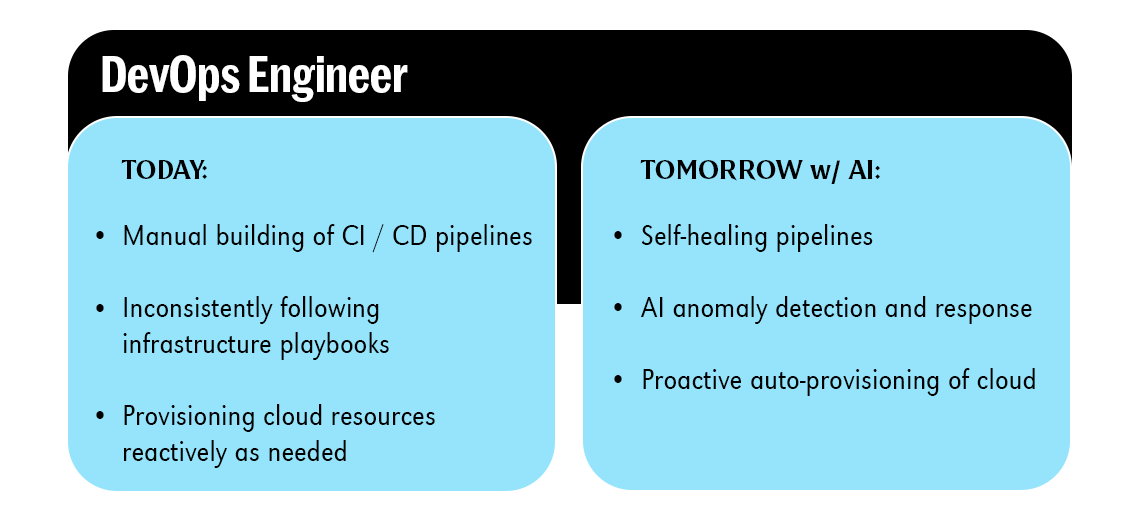
Looking back at these responsibilities, most are very rules-based – if X, then Y. That’s why we’re excited about AI managing DevOps workloads in the following ways:
In the short-run…
- Self-healing CI/CD pipelines: AI can help identify and remediate pipeline bottlenecks, while also managing and optimizing the initial setup.
- Incident management becomes proactive vs. reactive: Instead of relying on static alert thresholds, AI can dynamically detect anomalies and suggest remediations.
- The auto-generation of Infrastructure as Code (IaC) templates: Since most engineers aren’t proficient in setting up IaC services like Terraform, LLMs allow them to do it via NLP prompting.
- Provisioning and scaling virtual machines and cloud resources: As SWEs increase the pace of feature development, AI can automatically build and deploy the necessary machines and cloud infrastructure to scale products.
In the long-run…
- AI DevOps engineers will be assigned tasks in JIRA, Linear, and other task management apps: Companies will specify which tasks humans will do, coding agents will do, and their AI DevOps engineers will do.
- DevOps teams will not need to know how to write code. They will focus on mastering systems architecture, best-in-class tooling, and how to properly scale cloud and compute resources.
IT
Few teams are as perpetually understaffed as IT. Organizations typically start investing in internal IT resources around the 200-300 employee mark, then add roughly one IT resource for every ~150 employees. From what we have observed, IT responsibilities and team structures are usually split into two main buckets: help desks and system administrators.
Help desks respond to internal employee tickets on an ad-hoc basis and manage recurring workflows like onboarding new hires. System administrators take a more proactive role, identifying new software tools, vetting procurement requests, and working with cybersecurity teams to ensure tools and privileges are provisioned correctly. Once again, this split highlights the balance between reactive and proactive work.
IT teams operate almost entirely through tools. While some may leverage command-line prompts, most tasks are completed using internal IT management systems like ITSM platforms (e.g. Moveworks) and mobile device management tools (e.g. JAMF), or using the software employees need help with. While MCP and computer-use agents can make interacting with tools easier, they still require domain-specific context to avoid constant HITL intervention.
That’s why we believe there will need to be IT-specific AI companies that can build knowledge graphs to consistently deliver the right context to agents to solve assigned tasks.
Finally, IT sits at the gateway to a broader enterprise knowledge automation layer. Many systems IT interacts with are also used by legal, HR, finance, and compliance teams to handle low-level tasks for employees. By becoming the AI-powered IT layer, companies can eventually broaden their scope and become the go-to platform for knowledge and task resolution across the company.
To start, here are some of the highest value ways we believe AI can automate IT work:
In the short-term…
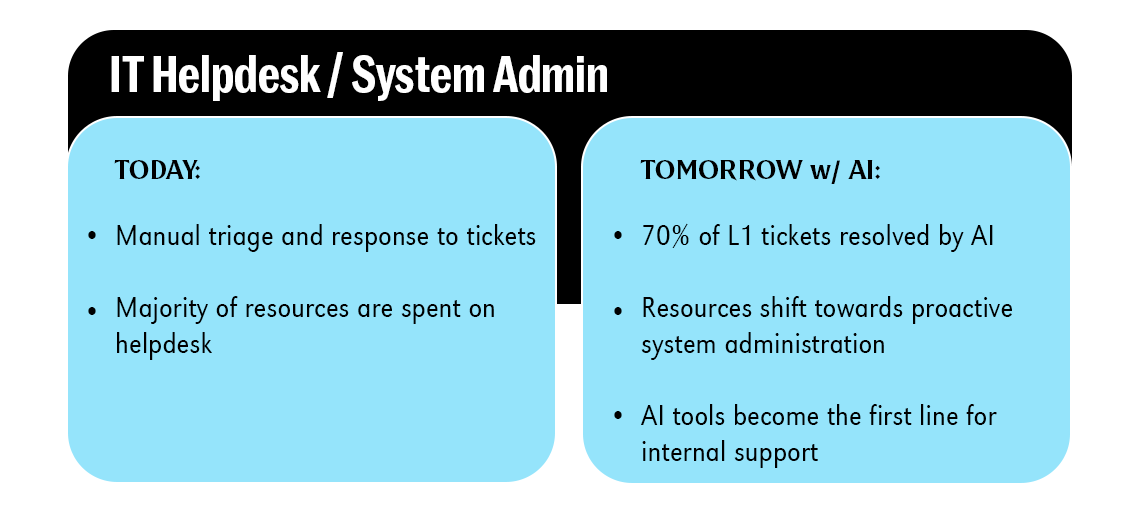
- L1 Helpdesk work will be majority done by AI: We’re seeing new AI firms automate 50-60% of existing tickets, driving huge immediate ROI.
- Access and identity management will be run by AI IT teams: AI is well-suited to use a company’s access / provisioning policies, administer them, and police for any violations.
- AI IT teams will slowly eat into the work MDM companies handle: By building context on users to better automate their IT tickets, AI IT companies can also begin to eat into some of the asset management automation work that MDM companies do.
In the long-term…
- Large IT MSPs that historically had thousands of employees will have less than a couple hundred: The ratio of IT analyst : employee will go from 125:1 to closer to 500:1.
- AI IT companies will become the front door for employee tooling usage: Any desired change to an employee’s tooling setup or personal data, ranging from changes in healthcare benefits to PTO, will go through AI IT companies. They will replace employees’ initial questions to internal teams that start with “How do I…?”
Network Engineering
Dig through your LinkedIn connections, and you probably won’t find many network engineers. Yet as more people come online and networks expand in complexity, network engineers are increasingly in demand. They’re responsible for responding to network outages, proactively monitoring network health, and proactively scaling and improving network infrastructure. This work has become especially critical given that the OpEx of 5G rollouts has been higher than expected for Internet Service Providers (ISPs). We’ve heard that most ISPs are paying around 20% of their revenue in support costs, hastening their desire to find AI solutions to help them efficiently scale.
Network engineers largely work via command-line interfaces (CLIs), tools like Cisco’s NSO or Jupiter’s Apstra, and infrastructure-as-code platforms like Terraform or Ansible. This setup makes it harder for them to leverage code generation tools like Cursor or Windsurf. Additionally, the context that network engineers need to solve problems isn’t found in a Git Repo but in observability tools like Grafana or Prometheus.
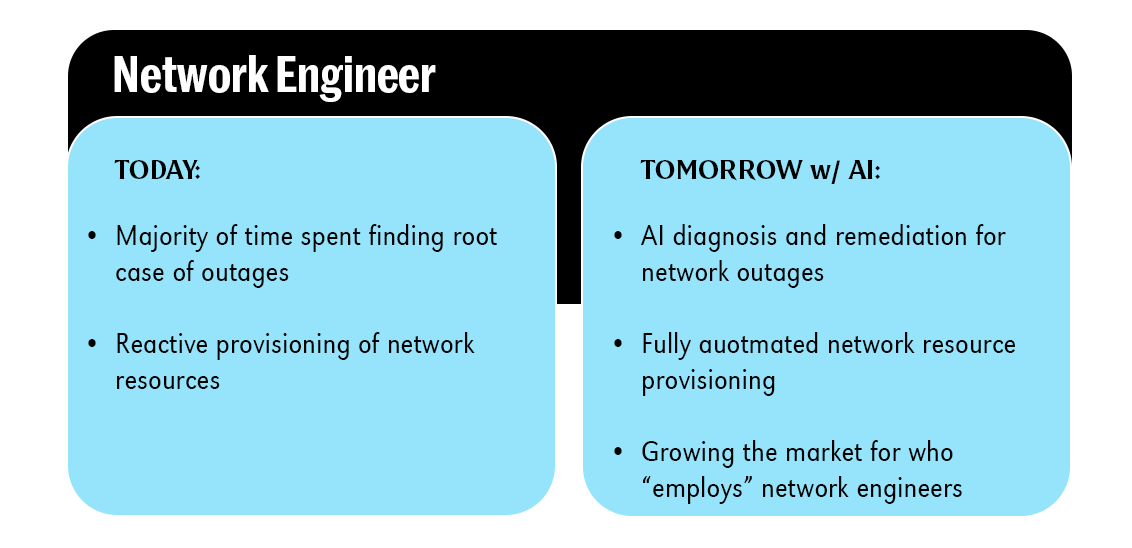
Similar to IT, we believe AI can meaningfully automate many of the reactive parts of a network engineer’s responsibilities. By instantly diagnosing outages and finding the root cause, AI network engineers can reduce the size of network operations teams. On top of that, provisioning network resources could go from being a rote manual task for network engineers to being something that AI can handle automatically when triggered. In this new world, network engineers would go from being CLI-jockeys to focusing on more architectural problems like designing holistic intent-based policies, building scalable topologies, and ensuring that their networks can handle future growth.
Here are the ways we think AI network engineers can add value:
In the short-term…
- Outage diagnosis and response times will decrease fivefold: AI network engineers should be able to identify why an outage occurred and help a senior network engineer get part of the way towards remediation.
- Network resource provisioning will become automated: The provisioning of new and existing network resources should become completely automated by AI, but validated by a HITL network engineer.
- AI will even begin proactively suggesting network configurations: Through integrations with the observability stack, AI network engineers should be able to not only monitor networks for anomalies but also suggest proactive changes to help prevent future ones.
In the long-term…
- AII will expand the number of companies that will have network engineering teams. More companies will “hire” AI network engineers as the cost of doing so goes down and network complexity / importance increases.
- There will be major outages that are entirely remediated by AI. Outages that have 100% software-driven remediations may be completely handled by AI network engineers.
The Other Engineering will follow a similar path to software engineers: low-level, repetitive work will be automated by always-on AI tools, freeing employees to focus on more proactive and strategic tasks. Unlike SWEs, code generation alone does not solve their challenges. These teams rely on specialized tools that require relevant context to be used effectively, creating an opportunity for startups to build verticalized AI employees tailored to these verticals.
Many enterprise CIOs we’ve spoken to are actively trialing AI products for The Other Engineering teams and plan to double down on a few starting next year. If you are building AI for the Other Engineers or any other forgotten technical teams, we’d love to hear from you – please reach out to wendy@northzone.com